Tuesday, August 9, 2011

The Bugaboos


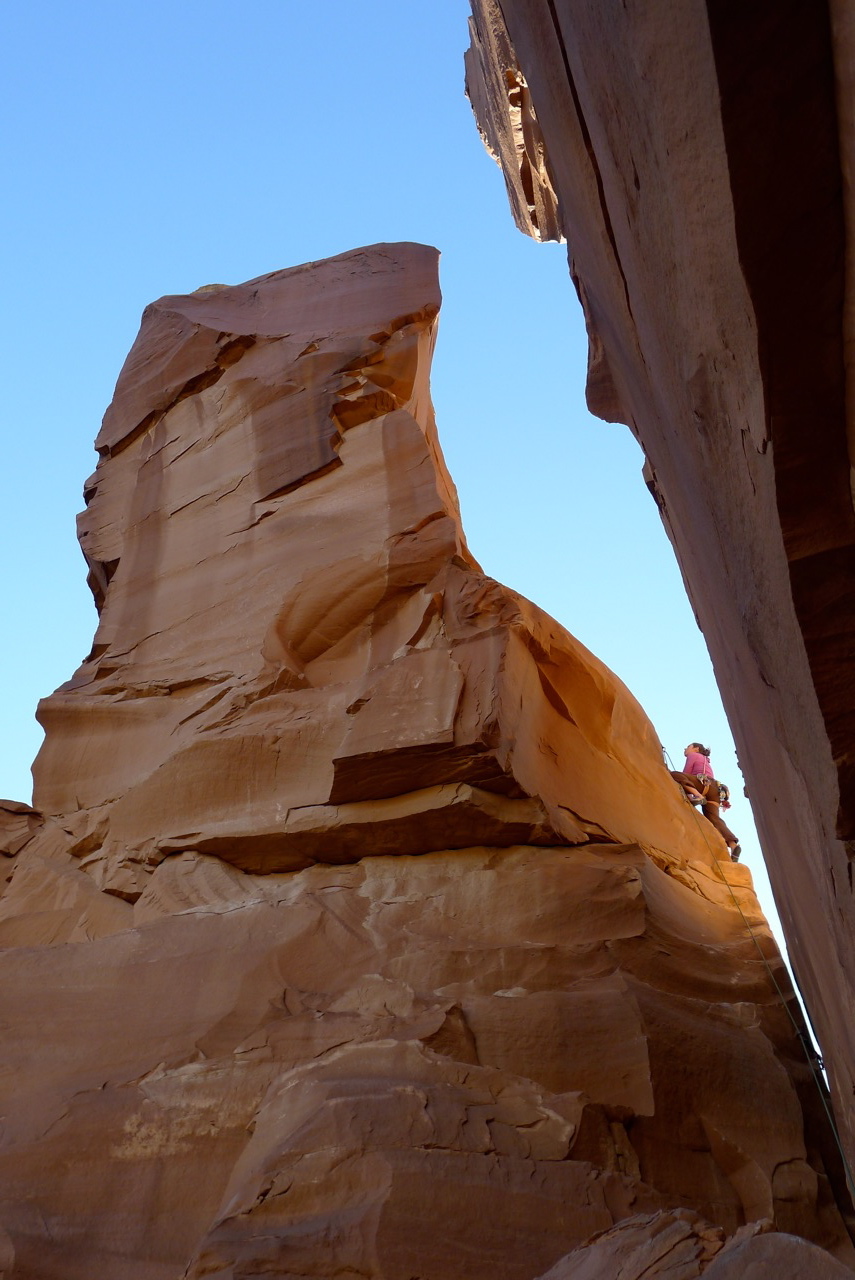
Crossing the Au Chevel on Pigeon Spire. Photo Loren Rausch.

I have wanted to climb in the Bugaboos since I first heard about the park seven years ago. I bought a guidebook about five years ago and since then it has been sitting on my bookshelf waiting to get put to use. Last winter, Sam and I started scheming about adventures we could do during the summer. We both were super excited to check out the Bugaboos and finally a trip to the area was put together!

The place lives up to the hype of an awesome alpine playground. Once at the basecamp, the access is great and amazing climbs can be reached within a 30 minute walk. The rock is generally excellent and there are many bolted rappel stations that help make the alpine terrain feel very safe.

Evening light on Snowpatch spire. Photo Sam Goff.

We packed food for about a week and began our hike into basecamp on July 30. It was hot and sunny and it looked like high pressure weather would remain throughout the week. The trail is steep but is immaculately maintained with lots of stairs cut out of the rock and handlines made from chain that have been bolted into the rock in the exposed areas.

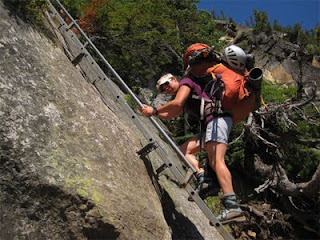
Our packs were really, really heavy. We guessed between 60-70lbs and it took us close to 4 hours to slowly and leisurely hike in to Applebee campground. We were a little taken aback at how many tents there were at the campground. It was quite crowded and earplugs were a mandatory piece of equipment. It didn't exactly feel like wilderness experience. But there is a reason that many people tend to visit this park. It is a beautiful place with great access and quality rock. Sometimes climbing isn't entirely about an isolated, alpine adventure. Instead it can be about sharing the routes and the beautiful places with others. It can be about meeting new people and creating a sense of community at a tiny belay ledge.

The "scene"


On our first climbing day, we went up McTech Arete, a 5 pitch 5.10a on Crescent Spire. There were 4 excellent pitches and 1 short pitch of 4th class choss. There is only a move or two of 5.10 climbing so the climbing goes pretty quickly. It was a great introduction to the area and also a great route for a short, mellow day.

Sam following the first pitch

The second pitch
Topping out on the McTech Arete. Photo Sam Goff.

The next day we work up early so that we could do the Northeast ridge of Bugaboo Spire, IV, 5.8. The first 4-5 pitches were interesting and fun, crack climbing and some face climbing across a dyke. The remaining pitches were pretty low angle and went up through a chimney system that is best climbed by stemming and using the holds on the outside of the chimney. But what makes this route awesome is the amazing setting. The views from the ridge are outstanding and you can see far into the north and south. Views of granite spires and glaciers are endless! The descent for this route is down the opposite ridgeline (the Kain route) and so you end up traversing the whole peak from North summit to south summit and then down the Kain route. We had heard that it is easy to get lost on the traverse and descent and maybe if there weren't so many people descending we might have gotten lost but the guidebook (by Chris Atkinson and Marc Piche) also describes the terrain and descent in quite accurate detail. Or maybe we are just amazing routefinders?!

The NE ridge climbs the right skyline and the Kain route descends the left skyline

Finishing the second pitch

Up high on the NE Ridge. Photo Sam Goff.

Doing some routefinding. Photo Sam Goff.

Somewhere between the north and south summit. Photo Sam Goff.

Our final climb was an ascent of another one of the Bugaboos famous moderate classics, the west ridge of Pigeon Spire, 5.4). We simul climbed up and solo-ed down. I'm not that into soloing but this felt very secure and I would definitely solo it again. The funny part about this climb is that we just brought rock shoes and there was quite a bit of snow on the route (which you could see from the approach, if you were actually looking). So it was a bit slippery and cold climbing the snow with our little rock shoes. Fortunately there were some nice steps and I pioneered my own way towards the summit on the final 100 feet through the undisturbed lichen covered slab instead of remaining on the snow covered steps up the slab. It was entertaining!

Descending down to the first summit.
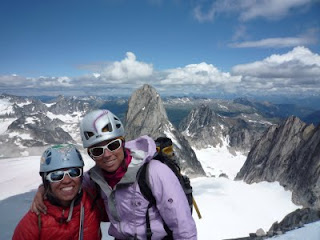
Sam and myself on top of Pigeon

With this trip, I have gotten a taste of what the Bugaboos have to offer and I look forward to going back and having more adventures in the future!

Thursday, July 28, 2011

Dirtbag Diaries Episode


About a year ago my friend Fitz interviewed me about my epic in Patagonia for his podcast the Dirtbag Diaries. Fitz and his wife Becca put together another great episode and I am super pleased at how it turned out. These guys continue to set the bar high for creativity and thoughtful storytelling. Check it out: http://www.dirtbagdiaries.com/


Tuesday, July 12, 2011

Gear Review: Petzl Sum'Tec Ice Axe

Petzl’s Sum’Tec ice axe is my new favorite mountaineering ice axe. It has the features of both a traditional mountaineering axe and a more technical tool so it is ideal for glaciated and alpine routes with shorter sections of steep ice and snow. It could also just be used as a single tool for mellow mountaineering routes in addition to becoming a second tool for steeper alpine routes. The tool swings well and is easy to climb leashless since it has the adjustable trigrest hand rest, which is an excellent feature in itself. The pick is interchangeable and it is curved and aggressive enough for swinging into vertical terrain.

Drawbacks are the weight of the tool. It is a bit on the heavier side for a mountaineering tool at 485 grams for the 52 cm tool. Also the trigrest unfortunately did not remain very tight on the tool and slid off the tool at one point in time. I’m not sure if this was due to cold temperatures or a lack of tightening of the screws. It would also be nice if this tool could come with a hammer instead of an adze for added versatility. Apparently a hammer version will be released soon.

Overall, this is a fantastic tool for alpine routes that have both mellow glaciated walking sections combined with steeper snow and ice sections. I look forward to taking it with on my next alpine adventure!

Topping out on the fixed lines (16, 200 ft) on Denali

Tuesday, May 31, 2011

Spring Rock Climbing


La Cucaracha in Icicle Canyon, Leavenworth. Photo Jonathon Spitzer

It has been a rainy spring in Washington and sunny days have been limited. Despite the lack of sunshine, I have still managed to hit up most of the local Seattle cragging areas. During the long winter in Seattle much of my energy gets directed towards school, so the first couple days back on the rock always feel a bit awkward and clumsy. For me, the spring rock climbing season is about re-learning techniques, getting a feel for the rock and getting the mental game back in shape. I spent a day or two warming up on the mellow sport climbs at Exit 38. I went out with my rope gun friend, Kevin, to climb some of the classic overhanging sport routes at Little Si. It is always a little humbling to struggle up a climb that I once had felt so confident on. But so it goes. There are ebbs and flows in all parts of life and that includes climbing too.

Kevin warming up on the polished rock on Girls at the Gym at Little Si

A couple days were spent in Leavenworth getting in milage on moderate climbs, honing slab climbing techniques, and hanging out with my east side friends.

Sam on Straight Street. Photo Kelsey Ferguson.

Givler's Crack. Photo Jonathon Spitzer.


Bo Derek. Photo Jonathon Spitzer.

Photo Jonathon Spitzer.

I had a couple glorious days cragging at Index. When the sun shines at this crag and the temperatures remain around 65-70 degrees, there is not a whole lot to complain about. After several rainy days, parts of the climbs can still remain wet and that makes for some extra excitement!

Top-Roping an obscure, bolted offwidth/layback through the mossy wettness
Can't complain about views like this!

Thursday, April 7, 2011

Gear Review: Petzl Nomad 9.8mm & Fuse 9.4mm Climbing Ropes

by Jonathon Spitzer

For the past couple years, I have been climbing on Petzl ropes. In both the alpine or cragging environment they remain durable and trustworthy, while also keeping weight to a minumum. The following is a review that Jonathon Spitzer wrote about our favorite Petzl ropes.


Nearing the summit of Poincenot, Patagonia, Argentina

In 2008 I was training for my AMGA rock exam. This exam would be the final exam to complete my IFMGA guide certification. I purchased my first Petzl rope to use for training and during the exam. My climbing partners and I traveled around the Western United States in search of ideal training grounds. We subjected this rope to coarse granite, sandy belay ledges, big whippers, extensive short-roping, precipitation and dirt bag style living. It was even a pillow for a night! This rope remained durable and trustworthy throughout the process. Since then, I have been using Petzl climbing ropes for both guiding and personal climbing. I primarily use the 9.8mm Nomad and a 9.4mm Fuse.

All Petzl ropes come with the “climb ready coil” which helps avoid the agonizing rope cluster and endless re-stacking of the rope before being able to use it. The distinct middle mark is a requirement for me these day before purchasing a rope. All Petzl ropes have a large black section denoting the middle mark of the rope. The Duratec dry treatment helps prevent the rope from absorbing water, which is key when you find the rope in a puddle of barley freezing water at the base of an ice climb. Both of these ropes are offered in 60 meters or 70 meter lengths.


Coiling the rope on the top of one of the Bridger Jack Spires, UT

The Nomad 9.8mm is a great all around rope for rock and ice climbing. I tested this rope on Indian Creek’s splitter cracks, coarse granite at Index, WA, and New England ice climbs, and have found that the thick sheath has held up well from abrasion. This rope has become my “go to rope” for rock climbing and ice climbing. I recommend this rope for multi pitch rock climbing, top-rope climbing, cragging, and ice climbing.


The Fuse at 9.4 works great in the alpine environment and also on long multi pitch rock routes. Last spring, I used this rope while climbing technical alpine mixed routes in the Alaska Range around Mount Hunter. I also use this rope on a professional level and it has become my “work horse” rope while alpine guiding in the Cascades, WA and the European Alps.

The solid foundation and creative design that has given Petzl a strong reputation in the outdoor industry has also been used in the development of these ropes. Petzl continues to deliver quality equipment while keeping safety paramount. A Petzl rope will always be in my backpack for the next day of cragging, guiding or international adventure.

For more information on the entire Petzl dynamic rope line visit
http://www.petzl.com/us/outdoor/verticality/dynamic-ropes

Jonathon in Red Rocks, NV

Friday, April 1, 2011

Desert Rock Climbing


Heading up the final sport pitch on Easter Island. Photo by Jonathon Spitzer.

In late March, Michelle and I packed my tiny honda up and drove south to the Utah desert. We were in search of sunshine, desert splitters and friends. There is something invigorating and refreshing about the southern Utah desert. I've spent quite a bit of time tromping around down there and it never seems to get old.

On top of Easter Island. Photo by Jonathon Spitzer.
Since my life in Seattle is often over booked with school related activities, I have very little time for climbing. I go to the gym several times a week but its not quite the same as climbing outside. When you don't get to climb all the time, the short trips mean so much more. I had hopes of cramming all my climbing goals into this brief trip. Weather and tired muscles dictated otherwise.

Dana Larkin climbing on the Scarface wall. Photo by Jonathon Spitzer.
This is my third trip to the desert that I have brought the rain with me from Seattle! We had snow, hail, sleet, rain and a couple classic bluebird days. On those sunny days, I tried to climb as much as possible. Despite aching muscles, bruised appendages and sore feet, I felt pretty good up high on the rock. I always seem to forget how physical the climbing is in the desert. When the trips are short its hard for me to convince myself to take rest days. I paid the consequence for that when I could barely get myself off the ground on a climb that I know I could have done easily if I was fresh. The disappointment in that day reminds to strive to quality versus quantity.

Michelle heading up.
Climbing continues to deliver some of my most valuable memories and experiences. From laughing with close friends, to athletically moving through a challenging sequence to finding the meditative focus necessary to push through to the next move. Thank you desert for providing a brief moment of raw serenity.

Photo by Jonathon Spitzer.


Gear:
Petzl Hirundos Harness
Petzl Spirit Quickdraws
Petzl 3-D Attache Locking Carabiners
Petzl Elia Helmet
Petzl Nomad 70m 9.8 Rope
Julbo Whoops Sunglass with Zebra lenses
Many Black Diamond cams

Sunday, February 27, 2011

Skiing in the Ruby Mountains, Nevada


Jonathon had promised me that this was going to be the best skiing I had experienced all winter. I was excited to finally make some turns in fluffy, white powder. We started the weekend by cat skiing with the guests on some low angle terrain.
I have to admit that I wasn't that impressed by the skiing. I wouldn't consider myself too much of ski snob but we didn't get the face shots that Jonathon had been promising. Granted it was better than anything that I had skied in Washington all winter.

Overnight it snowed over a foot and finally Jonathon delivered his promise. We got a ride up on the helicopter to the top of this run called, "the beaver." The lightest and deepest snow awaited us for a glorious 1200 foot run. It was amazing. We skinned back up and then skied another awesome 5000 foot run back to the car.
The next day sunny skis were delivered and we skinned up through Lamoille Canyon. High avalanche danger dictated that we keep it conservative but we still had an amazing 1500 foot run of creamy powder!

The terrain in the Ruby's makes for a truly unique skiing experience. The range is characterized by a high, alpine desert where the lowlands are filled with sage and willows. Much of the skiing is above tree line and rocky sandstone cliffs emerge from the hillside, providing a truly scenic backdrop. This place is truly undiscovered and there aren't too many people skiing here except for the Ruby Mountain Heli Operation guides and guests. There is a ruggedness and remoteness to the range that gives it a big mountain feel. The desert air keeps the atmosphere pretty dry and low density snow tends to fall heavily throughout the winter. I definitely want to do some more exploring and I'm looking foward to a longer trip next winter!